|
|
|
| |
| |
| Capitol Report |
#Listrak\DateStampLong#
|
The latest news from the State Capitol
|
Please do not reply directly to this email, as it returns to an unattended account.
You are welcome to contact me through this link.
|
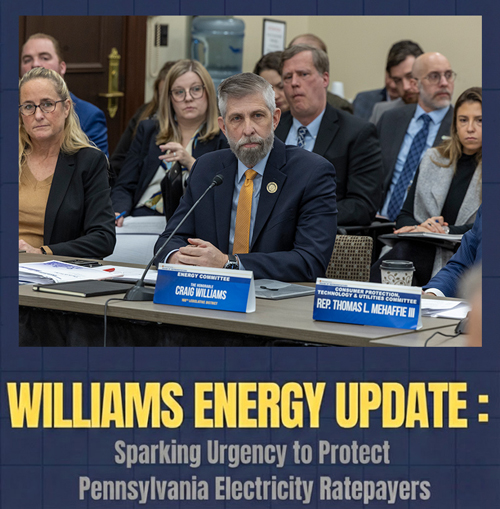
Sparking Urgency to Protect Pennsylvania Electricity Ratepayers
A lady recently contacted our office very upset by her electricity bill. She said her most recent bill was over $700, which is almost as much as her mortgage. I spoke at an event where I asked the room how much they were paying, and $700 was the low amount. That is frankly ridiculous for a state which is a huge electricity exporter to other states.
I have been making that point very loudly in several venues. Let me tell you where and what I am advocating in Pennsylvania.
I was invited to participate in an energy policy hearing with the Maryland House of Delegates on electricity affordability and regional grid reliability. One of the witnesses was a spokesman for PJM, and as we have discussed many times, the capacity market is now the single biggest driver of the price spikes showing up in our electric bills. Weather and short-term demand certainly matter, but the long-term structural problem is that capacity prices have exploded, because the region does not have enough generation to meet the demand that is coming. (Remember, the capacity market is a promise guaranteed by a payment for generators to be available in the future when called upon. They can make a lot of money on the market right now, so they are insisting on premiums to be reserved for future power.)
Pennsylvania sits in a very different position than many of our neighbors. We produce more electricity than we use, and we export that power through PJM. Maryland, by contrast, adopted some of the most aggressive emissions-reduction mandates and renewable portfolio standards in the region, joined RGGI and predictably drove coal generation offline. Natural gas investment was discouraged as well, and while nuclear remained online, no new nuclear was added to replace what was lost. The result is simple: Maryland now imports a large share of its electricity from states like Pennsylvania while claiming the benefits of a cleaner grid. They did not eliminate demand. They eliminated their ability to meet it. And they meet their demand with our natural gas generation.
The capacity market did the accounting. When states retire generation faster than they replace it, capacity prices rise for everyone. Now PJM has temporarily capped those prices, and the practical effect is that Maryland gets a huge discount on the capacity price they should pay for its own lack of generation, while Pennsylvania consumers pick up part of the bill. We did not cause the problem, but we are absolutely paying for it. That is not sustainable, and it is not fair. Pennsylvania should not be subsidizing the consequences of other states’ bad policy decisions, especially when we are working every day to protect reliability and affordability for families here at home.
I participated in a joint hearing of the House Energy and Consumer Protection, Technology & Utilities (where I sit as a Utilities Subcommittee Chair) Committees last week on this same issue, where PJM testified again. I asked the same question I asked them in Maryland: is it time for Pennsylvania to leave PJM? Is it time for Pennsylvania to put a price fence around our power generation – taking care of Pennsylvanians first – and charge a premium for below-capacity states? As I said to that panel, it is time for other states to bear the costs of their own decisions and for Pennsylvanians to benefit from the excess electricity produced from our natural resources.
With that backdrop, let me say plainly where I think we need to go next.
Hyper-scalers (like data centers) are looking for regulatory certainty in determining where to build. Pennsylvania sits in a fairly unique position relative to our ability to produce a ton of electricity. But our policy environment has discouraged that development. I have heard estimates that, while we sit in an energy surplus now, we will be in a deficit by the end of the decade, because we are not building. It is almost too late.
1. We need a simple-to-follow law. Every large load customer (and here we are talking about these hyper-scalers, like data centers, not our industrial partners) should Bring Your Own Generation (BYOG). That means they are adding generation to our grid, not simply competing with us ratepayers for scarce resources. That competition for limited generation now for future power is the biggest cause of your bill increases. Let’s eliminate that scramble in Pennsylvania now as a matter of policy.
2. These hyper-scalers need to pay their own way down to the last dollar. That means they pay to connect to the transmission and distribution systems as required; they pay for any infrastructure buildouts needed from our utilities. That means the transmission companies and our utilities get paid without us – the ratepayers – subsidizing those costs. Hyper-scalers in other states are already willing to meet those demands if they have certainty.
3. Our Pennsylvania merchant generators (the unregulated companies making electricity) are making a ton of money right now. Some of them are entering into long-term power purchase agreements with hyper-scalers with the power we usually purchase through our utilities (on our default service's behalf). They do not like BYOG, because the economics are rewarding resource scarcity (when supply is limited and demand goes up, prices go up). I will be running legislation to require our utilities as default-service providers to adjust their procurement schedules to include long-term power purchase agreements just like the hyper-scalers, so that we ratepayers have long-term price security. A typical term is one to two years currently. We need contracts of the same magnitude as the hyper-scale long-term contracts to keep our power in the consumer market. Generators should prefer that economic certainty too. Combined with BYOG, the promise of additional generation, regulatory certainty and long-term agreements for ratepayers will reduce and stabilize prices in Pennsylvania.
Pennsylvania produces electricity for much of the region. Our ratepayers deserve to benefit first from that strength. I will continue leading efforts to expand supply, assign costs fairly and protect families from unreasonable electric bills driven by regional policy failures.
|
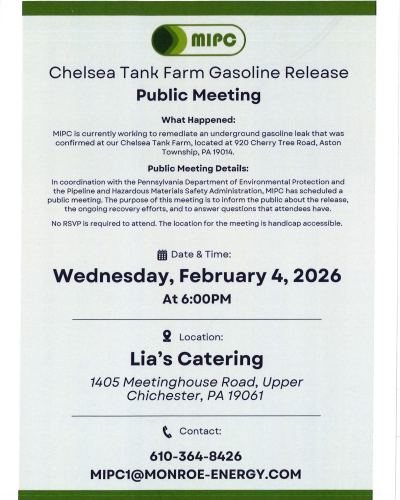
MIPC Public Meeting Scheduled on Chelsea Tank Farm Remediation
Monroe Interstate Pipeline Company (MIPC) is currently remediating an underground gasoline leak at the Chelsea Tank Farm, located at 920 Cherry Tree Road in Aston Township. To be certain, we have neighbors in Bethel who adjoin that property.
In coordination with the Pennsylvania Department of Environmental Protection and the Pipeline and Hazardous Materials Safety Administration, MIPC has scheduled a public meeting to provide an update on the ongoing recovery efforts and answer your questions.
The meeting is on Wednesday, February 4, at 6 p.m. at 1405 Meetinghouse Road in Upper Chichester. We have session that day in Harrisburg, but I will attend if I am released from the House floor in time.
Residents with questions may contact an MIPC representative at 610-364-8426, by email at MIPC1@monroe-energy.com or visit their website chelseatankupdates.com.
Photo Credit: Facebook
|
Governor to Deliver Budget Address Tuesday
Gov. Josh Shapiro will deliver his 2026-27 budget address on Tuesday, February 3, before a joint session of the General Assembly.
The governor’s proposal begins the budget process. The House Appropriations Committee will then hold several weeks of public hearings to review the budget with agency leaders. This work gives lawmakers the opportunity to ask questions, press for accountability, and shape a final budget, reflecting the needs of Pennsylvania families and taxpayers.
Last year, I supported a bipartisan budget that delivered real progress for Pennsylvanians. The General Assembly continued funding for proven public safety efforts like Project Safe Neighborhoods, again increased spending for education, maintained key services for seniors and families and made responsible investments strengthening communities across the Commonwealth. I will approach this year’s budget with the same focus on practical results, fiscal discipline and priorities that matter here at home.
|
Heating Assistance Program Available
If cold temperatures have increased your home heating bills, help may be available through the Low-Income Home Energy Assistance Program (LIHEAP).
LIHEAP is a federally funded program that helps eligible households pay heating costs through grants sent directly to a utility company or fuel provider. The program also offers crisis grants for emergencies, including loss of heat because of broken equipment, lack of fuel, or utility shutoff.
To qualify in Pennsylvania, applicants must meet income requirements based on household size. For example, the maximum annual income is $23,475 for an individual and $48,225 for a family of four. For each additional person, add $8,250.
Residents may apply online at dhs.pa.gov/COMPASS, by phone at 1-866-857-7095, or through the Delaware county assistance office 610-447-3099 and Chester County assistance office 610-466-1042.
Click here for additional information. The program runs through April 10, 2026.
|
Around the District
U.S. 322 Bridge Work to Close Market Street Next Weekend
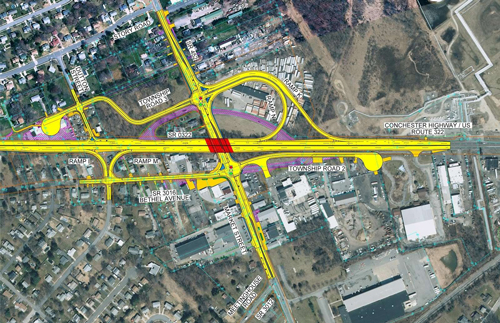
PennDOT will close a section of Route 452 (Market Street) next weekend in Upper Chichester Township so crews may demolish the eastbound side of the U.S. 322 bridge over Market Street.
From 9 p.m. Friday, February 6, through 6 a.m. Monday, February 9, Route 452 (Market Street) will close between Bethel Avenue and Story Road. PennDOT will post detours, and drivers should plan for extra travel time and possible delays.
U.S. 322 (Conchester Highway) will remain open with one lane in each direction during the work.
This project will widen and improve safety along a 1.4-mile section of U.S. 322 in Upper Chichester Township. Weather may affect the schedule.
Concordville Fire Department Hydrant Reminder
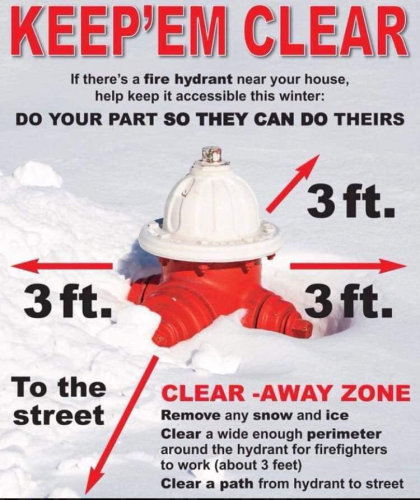
The Concordville Fire Department asks residents to keep fire hydrants clear after snowfall. Please shovel at least 3 feet of space on all sides of each hydrant. This helps firefighters access hydrants quickly during an emergency and supports public safety in our community.
Photo Credit: Facebook
Miss Brooke’s Music Class
Miss Brooke’s music class offers a warm and engaging experience for young children, with singing, shakers, drums, puppets, parachutes, bubbles, and more. This is a free event.
Saturday, January 31, at 10 a.m.
Concord Township Community Center (Lower Level)
45 Thornton Road, Glen Mills
Photo Credit: Facebook
Westtown Township Yard Waste Collection
Westtown Township requires residents to place yard waste in biodegradable paper bags or in containers that workers can empty. The township does not accept plastic bags.
Residents must cut branches under 3 inches in diameter into approximately 3-foot lengths. Residents must bundle and tie branches and place them at the curb by 6 a.m. on collection day.
The township will not collect rocks, logs, stumps, dirt, or ashes.
The next yard waste collection takes place Friday, March 6.
Westtown Sweetheart Stroll
Westtown Township Parks and Recreation will host the Sweetheart Stroll luminary walk at Oakbourne Park around the Oakbourne Mansion. Residents may enjoy a luminary-lit trail and refreshments from Travelin’ Toms Coffee Truck and Dia Doce Gourmet Cupcakes (for purchase).
The event welcomes all ages. More details will follow soon.
|
Bravo Zulu
*The BZ pennants are hoisted as a part of Navy/Marine Corps custom to communicate “GOOD JOB!”
Unionville Men’s Basketball
Unionville men’s basketball took down Kennett on Tuesday in a close 41-36 victory. With one more win Unionville will be back at .500 and in the hunt for District playoffs. Good luck Longhorns!!!
Photo Credit: Instagram
Unionville Track and Field
Congratulations to Brady Lasher on being named the Chester County Track and Field Athlete of the Week.
Photo Credit: Instagram
James Madison University Graduate:
Kimberly Delea, Health Sciences
College of Charleston President’s and Dean’s List:
Carly Torrens, Finance
Sophie Watson, Marketing
Campbell Eaton, Management
Matigen Wright, History
Tatum Kenney, Marketing
Ashleigh Shields, Hospitality and Tourism Management
Matthew Farrell, Business Administration
McDaniel College Dean’s List:
Carter Bucci
Commonwealth University Fall 2025 Dean’s and President’s List:
Elijah Borda, Anthropology
Madison Cialini, Criminal Justice
Ryan Downey, Business Administration
Calvin Fisher, Music Education
Matthew Pulcinella, Business Administration and Finance
Lilianna Maletsky, Undeclared Undergraduate
Amanda Kelly, Business Administration and Marketing
East Stroudsburg University Dean’s List
Isabella Jones, Communications
Arlen Chapman, Marketing
Braeden Brem, Marine Science
Isabella Mintz, Communications
Anastasia Dakes, Psychology
York College Dean’s List
Dominick Weaver, Electrical Engineering
Hana Hebert, Nursing
Antonio Santangelo, Supply Chain Operations Management
Samantha Ward, Political Science
William Evans, Finance
Alexander Ricciuti, Undeclared Undergraduate
Cameron Chandler, Sport Management
|
|
| Office Locations |
| District Office: |
| One Beaver Valley Road | (intersection of Route 202 & Naamans Creek Road) Chadds Ford, PA 19317-9012 | Phone (610) 358-5925 | FAX: 610-358-5933 |
| Capitol Office: |
| 3 East Wing, P.O. Box 202160, Harrisburg, PA 17120-2160 | Phone: 717-783-3038 | FAX: 717-787-7604 |
| |
|
|